



Author
Prof Dr Paul Heidekrüger
Reading time min.
Reading time min.
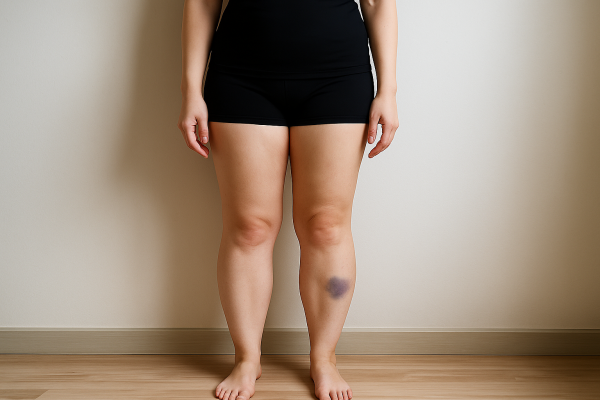
Bruises, medically known as haematomas, are caused by burst blood vessels under the surface of the skin. They are usually harmless and disappear on their own. But especially when they suddenly, for no recognisable reason or in unusual frequency it is worth taking a closer look. This is particularly noticeable in women with Lipoedema, from Large, painful bruises report - even with minimal force.
LIPOhelp®, your specialist for lipoedema, explains in this article:
Tips for prevention and long-term strategy
| Cause | Hint |
| Impact/bruise | Visible injury, localised pain |
| Blood thinners | Haematomas without a clear cause |
| Vitamin C or iron deficiency | Additional symptoms such as tiredness, brittle nails |
| Lipoedema | Pressure sensitivity, symmetrical haematomas |
| Vasculitis/capillary weakness | Petechiae, skin discolouration |
Lipoedema & bruises: Women with Lipoedema report an above-average number of large bruises. The reason for this lies in the disturbed fat distribution disorder: the affected tissue is more sensitive, the capillaries are more fragile and the lymphatic drainage is restricted.
Genetic factors, hormonal influences and certain autoimmune diseases can also favour a tendency to haematomas. Chronic complaints should therefore be further investigated by a specialist.
Not every stain is immediately a warning signal - but The following cases should be clarified by a doctor:
In particular, if bleeding occurs in several parts of the body at the same time or is accompanied by other symptoms such as fever or weight loss, more in-depth diagnostic steps should be taken.
Curd compresses or apple cider vinegar compresses help to reduce swelling
Lipoedema patients often experience haematomas not only as a visual problem, but also as a Painful problem, which has a significant impact on everyday life. The most important measures:
Many sufferers benefit from a multimodal therapy that combines medical, physical and psychological aspects.
Whether a small bruise after bumping into something or a spontaneous, large-area bruise - bruises can have both harmless and serious causes. Especially with lipoedema Preventive measures, Consistent therapy and Individual counselling decisive.
Make an appointment today with LIPOhelp® - Your expert centre for lipoedema, blood vessels and your health. We provide you with personalised and holistic advice.

Your opinion is important to us!
We would be delighted if you would publish your experiences on one of the following pages:


©2026 zellfusion GmbH | Munich
You need to load content from hCaptcha to submit the form. Please note that doing so will share data with third-party providers.
More InformationYou need to load content from reCAPTCHA to submit the form. Please note that doing so will share data with third-party providers.
More InformationYou need to load content from reCAPTCHA to submit the form. Please note that doing so will share data with third-party providers.
More InformationYou need to load content from reCAPTCHA to submit the form. Please note that doing so will share data with third-party providers.
More InformationYou need to load content from Gymnastics styles to submit the form. Please note that doing so will share data with third-party providers.
More InformationYou are currently viewing a placeholder content from Instagram. To access the actual content, click the button below. Please note that doing so will share data with third-party providers.
More Information