



Author
Prof Dr Paul Heidekrüger
Reading time min.
Reading time min.
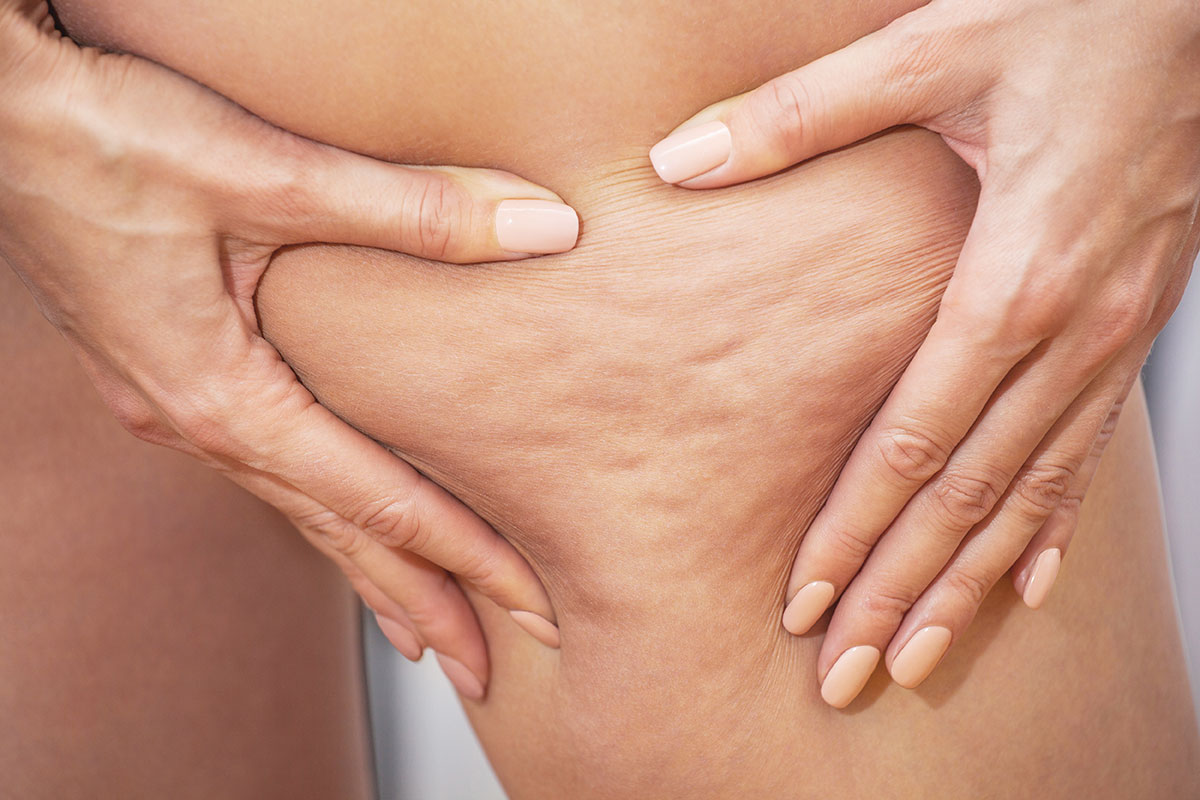
It's high time to break away from beauty ideals and accept that cellulite affects a large number of women. As a result, many have to struggle with the unsightly dents on their legs. However, most of those affected do not realise that the problem of orange peel skin can often be accompanied by lipoedema. So how can you tell whether you have lipoedema or cellulite?
The dimples on the thighs and buttocks are known as cellulite or orange peel skin. However, people often refer to this phenomenon as cellulite, which is not entirely correct, as cellulite is a serious disease caused by bacteria. In cellulitis, bacteria cause inflammation of the subcutaneous connective tissue.
How does cellulite develop? There is a prevailing opinion that cellulite is caused by being overweight. This statement is not correct either, as the severity of the skin symptoms increases with excess weight, but very slim women can suffer from it. The causes of cellulite are based on the anatomical structure of the female skin, which is criss-crossed by a large number of connective tissue strands. These strands of connective tissue attach to the subcutaneous tissue and can pull it in like the cords of a parachute, causing the unsightly dimples. Hereditary predisposition, stress, pregnancy and female hormones also play a major role in the development of orange peel skin.
Lipoedema is a symmetrical increase in fatty tissue on the legs, buttocks or arms. Women in particular suffer from this increase in fat. Lipoedema is not caused by being overweight, as initially assumed, but by a disorder of fat distribution in the body. Those affected usually complain of water retention, severe tension pain and pressure pain in the affected areas. In addition, the legs and arms often swell up so that they feel very heavy. However, the hands and feet characteristically do not swell.
In the early stages, the swollen and thickened legs are the most noticeable. In addition, small fat nodules can be felt in the depth of the skin. In the second stage, those affected notice a significant increase in volume, which may be accompanied by a general increase in weight. At this stage, patients often suffer from so-called saddlebags, i.e. very pronounced thighs in the outer hip area. Patients also often notice small bumps, which are particularly noticeable when standing. In addition, the fat nodules become larger and larger in the second stage and the congestion symptoms cause pain. In the third stage, the skin appears thickened and rippled, there is an overhanging flap of fat (so-called bulge or dewlap formation) and skin folds come to lie on top of each other.
In the first stage, cellulite can be noticed by squeezing the skin on the thighs, stomach or buttocks and observing dents and indentations. Small dents would not be visible in the normal state. In the second stage, these dents are directly visible without pressure. In some cases, pinching the skin can even cause pain. In the third stage, the cellulite is clearly visible even from a distance, the skin is flabby and dimpled.
In the case of advanced lipoedema, only liposuction can bring about a longer-lasting improvement. Liposuction is also known as liposuction in medical terms. Cellulite, on the other hand, can usually be treated with minimally invasive methods (if necessary in combination with liposuction) by cutting the connective tissue strands described above that cause the retractions.

Your opinion is important to us!
We would be delighted if you would publish your experiences on one of the following pages:


©2026 zellfusion GmbH | Munich
You need to load content from hCaptcha to submit the form. Please note that doing so will share data with third-party providers.
More InformationYou need to load content from reCAPTCHA to submit the form. Please note that doing so will share data with third-party providers.
More InformationYou need to load content from reCAPTCHA to submit the form. Please note that doing so will share data with third-party providers.
More InformationYou need to load content from reCAPTCHA to submit the form. Please note that doing so will share data with third-party providers.
More InformationYou need to load content from Gymnastics styles to submit the form. Please note that doing so will share data with third-party providers.
More InformationYou are currently viewing a placeholder content from Instagram. To access the actual content, click the button below. Please note that doing so will share data with third-party providers.
More Information