



Author
Prof Dr Paul Heidekrüger
Reading time min.
Reading time min.
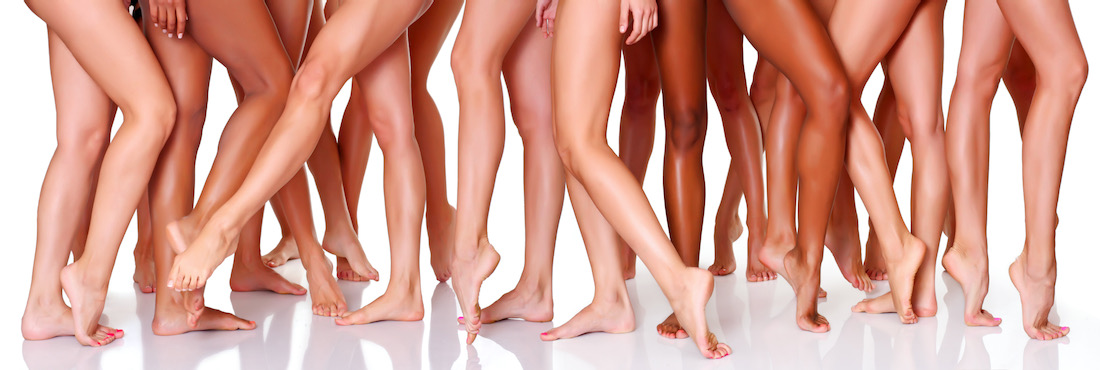
Beautiful long legs without dents and fat deposits - every woman dreams of this. However, the reality is that many women have fat deposits in their legs. While you can hide them in tights and jeans in the cooler months, in summer you are ashamed of your figure or feel uncomfortable. Although winter flab can be effectively combated with diets, exercise and weight loss programmes, these methods are often not very promising for stubborn fat deposits on the legs or the fat distribution disorder lipoedema. Sooner or later, liposuction - a body-shaping treatment also known as liposuction - will be necessary, especially in the case of lipoedema.
Before liposuction, a comprehensive consultation must be held with the specialist performing the operation. This is the only way he can inform his patient about the possible risks, the course of the operation and the costs. During liposuction, fat deposits in the legs are gently removed by suction. For this purpose, the specialist inserts thin cannulas through small punctures. These punctures are made in inconspicuous places and are sealed with plasters after liposuction, leaving only minimal and inconspicuous scars. A special compression garment must be worn after liposuction. This is customised to the patient's body and the corresponding area. The compression garment helps to reduce swelling and support the recovery and tightening process of the skin. It also promotes the healing and shaping of the body region.
Liposuction is possible on many areas of the body. If you have fat deposits on your legs, liposuction can be performed on the outer sides, front sides and inner sides of the thighs. In addition, liposuction can be performed on the knee region, lower legs and ankles in the case of fat deposits on the legs. Liposuction is also popular for riding breeches, whereby the buttocks are reduced in size. The hip area is often included in this procedure to achieve a particularly aesthetic result. In the case of fat deposits, where the inner thighs of the legs rub against each other when walking, the inner thighs are usually liposuctioned. In order to achieve the desired result, a detailed consultation with a specialist is recommended. They can explain where liposuction should be performed in order to achieve particularly attractive results. In the case of the fat distribution disorder lipoedema, a circular, somewhat more „radical“ and at the same time gentle procedure is necessary to treat the disease adequately.
A Lipoedema cannot be completely removed using conservative methods. As these are pathologically altered cells that lead to fat deposits in the legs and continue to multiply or enlarge, liposuction is necessary sooner or later.
The specialist surgeon first prepares the tissue with a special tumescent solution. He then inserts a cannula through several small incisions in the skin into the fatty tissue underneath. Lipoedema that has led to large accumulations of fat in the legs is usually treated using one of the following three methods:
These three methods have been used for years and are very popular in the treatment of fat deposits in the legs due to lipoedema. When carried out correctly, all three methods are very low-risk and effective. We have also found that gentle water jet and vibration-assisted liposuction in particular achieve effective and attractive results. We have also developed a special technique that enables virtually scar-free liposuction with a shorter recovery time.
You can find more information on this on our subpage Lipoedema surgery.

Your opinion is important to us!
We would be delighted if you would publish your experiences on one of the following pages:


©2026 zellfusion GmbH | Munich
You need to load content from hCaptcha to submit the form. Please note that doing so will share data with third-party providers.
More InformationYou need to load content from reCAPTCHA to submit the form. Please note that doing so will share data with third-party providers.
More InformationYou need to load content from reCAPTCHA to submit the form. Please note that doing so will share data with third-party providers.
More InformationYou need to load content from reCAPTCHA to submit the form. Please note that doing so will share data with third-party providers.
More InformationYou need to load content from Gymnastics styles to submit the form. Please note that doing so will share data with third-party providers.
More InformationYou are currently viewing a placeholder content from Instagram. To access the actual content, click the button below. Please note that doing so will share data with third-party providers.
More Information