



Author
Prof Dr Paul Heidekrüger
Reading time min.
Reading time min.

Lipoedema is a disease of the fatty tissue that often leads to severe discomfort and pain. Even a healthy diet and exercise do not help those affected to get rid of the symptoms. The so-called pinch test and the Stemmer test help to recognise lipoedema. What is it all about?
Lipoedema often leads to a spontaneous increase in volume in certain areas of the body. This usually affects the legs, but sometimes also the arms. However, hands and feet are usually left out. As a result, the body quickly appears disproportionate and inharmonious.
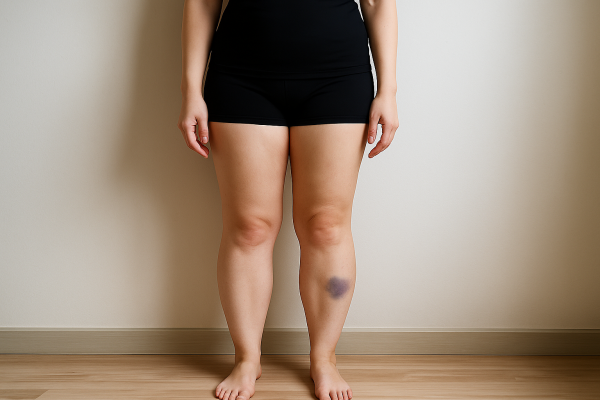
The skin of the affected areas feels soft as well as wavy and lumpy. This is why lipoedema is often confused with orange peel skin. However, these lumps can become larger and larger so that at some point they can be clearly felt under the skin. Pain also occurs as the disease progresses. Lipoedema also quickly leads to bruising. Even a light touch can lead to bruising. This is because the walls of small blood vessels are quite fragile due to the increased tissue pressure in lipoedema.
As lipoedema causes pain, the so-called lipoedema pinch test is a common method of diagnosing the disease. While there is no severe pain if the legs of a healthy woman are too fat or if she is overweight, lipoedema is characterised by tenderness, pain to the touch or pressure pain. The lipoedema pinch test on the arms and legs can be used to determine whether these are affected by the disease. But how is the lipoedema pinch test carried out?
Gentle pinching in the affected areas quickly causes severe pain if lipoedema is present. Pinching the stomach or back, on the other hand, does not hurt. In addition, the lipoedema pinch test shows that there is more pain on the outside of the legs than on the inside. However, in healthy people who do not have lipoedema, the opposite is usually true.
The so-called Stemmer's sign is a clear criterion for recognising lipoedema and distinguishing it from lymphoedema. The Stemmer's test is carried out by a doctor. He tries to lift a fold of skin above the second or third toe. If this is successful, it is a case of lipoedema. However, if the skin fold cannot be lifted, it is a case of lymphoedema, which must be treated differently. The Stemmer test therefore helps to clearly categorise the symptoms.
Anyone who frequently has bruises without knowing where they come from and suddenly gains weight on their legs or arms despite a healthy diet and exercise is at risk of suffering from lipoedema. Whoever has this Symptoms can carry out a lipoedema pinch test or a lipoedema stemmer test themselves. You can also go to a specialist Doctor is advisable. With the help of specific pinch tests on the arms and legs, the doctor can clarify whether it is a Lipoedema or not. In any case, it is better to see a doctor early than too late.
For further information, you can of course contact our LIPOhelp® team at any time. Contact us!

Your opinion is important to us!
We would be delighted if you would publish your experiences on one of the following pages:


©2026 zellfusion GmbH | Munich
You need to load content from hCaptcha to submit the form. Please note that doing so will share data with third-party providers.
More InformationYou need to load content from reCAPTCHA to submit the form. Please note that doing so will share data with third-party providers.
More InformationYou need to load content from reCAPTCHA to submit the form. Please note that doing so will share data with third-party providers.
More InformationYou need to load content from reCAPTCHA to submit the form. Please note that doing so will share data with third-party providers.
More InformationYou need to load content from Gymnastics styles to submit the form. Please note that doing so will share data with third-party providers.
More InformationYou are currently viewing a placeholder content from Instagram. To access the actual content, click the button below. Please note that doing so will share data with third-party providers.
More Information